csisensor — WiFi-CSI Vital Signs
Real-time heart rate & breathing from plain WiFi signals — ESP32-S3 firmware all the way to a PyQt5 GUI.
ACTIVE2026C++ · ESP-IDFPythonMQTTSciPy · FFTPyQt5Dockerpytest
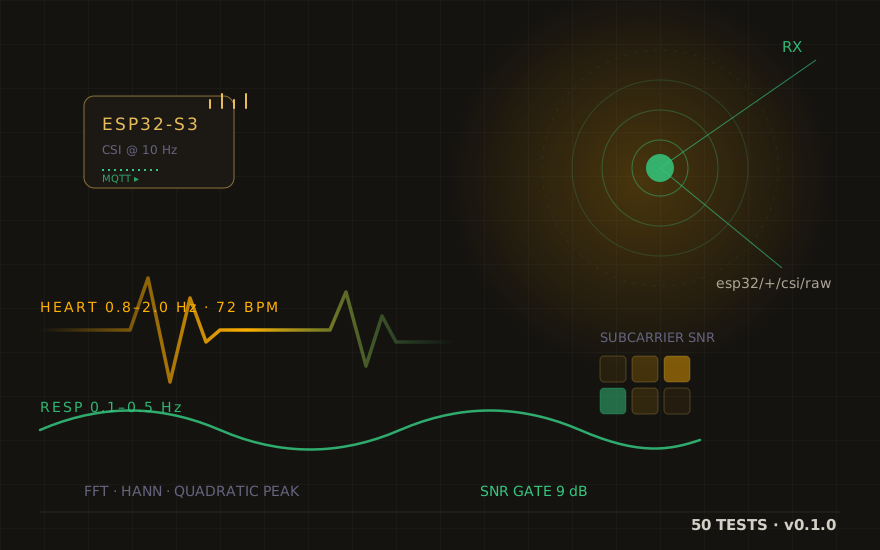
Real-time heart-rate and breathing estimation from WiFi CSI — the channel state information an ESP32-S3 can read from ordinary radio waves. No wearables, no cameras: RF physics, careful DSP, and 50 tests that keep the whole thing honest.
The pipeline, stage by stage
- Firmware — an ESP32-S3 captures per-subcarrier CSI amplitudes at ~10 Hz on ESP-IDF (the
CONFIG_ESP_WIFI_CSI_ENABLEDpin insdkconfig.defaultsexists because I hit the boot loop without it) and publishes compact CSV over MQTT. Credentials are read from NVS at boot with a serial provisioning protocol — one flash, then any network changes run through a 30-second pyserial script instead of a rebuild. - Broker — Mosquitto in Docker, with the config baked into the image at build time so
docker compose upworks from PowerShell over the\\wsl.localhostshare. - DSP backend — a Python service (paho-mqtt + SciPy) keeps a 15-second sliding window per board, selects the strongest subcarrier per physiological band (respiration 0.1–0.5 Hz, heart 0.8–2.0 Hz), bandpass-filters it, and runs a Hann-windowed FFT with quadratic peak refinement and an SNR quality gate. Motion presence (Absent / Still / Moving) comes from mean-amplitude statistics, and RSSI feeds a calibratable log-distance estimate.
- Interfaces — a PyQt5 GUI with physics panels (subcarrier heatmap, spectrogram with band markers, motion energy) plus an aiohttp LAN viewer any phone can open — no install, no CDN.
The engineering that makes it defensible
- Multi-ESP32 fusion — every board publishes to
esp32/<id>/csi/raw; the backend fuses per band by best in-band SNR, with a 16-link registry cap and dead-link failover inside 20 seconds (the polled primary expires too — that was a review finding I fixed). - 50 headless pytest cases covering the estimator, packet parser, motion analyzer, link manager and web pipeline.
- An empirical validation protocol written down: empty-room falsification (the negative control), metronome-locked breathing at 6 and 12 breaths/min, movement response, and a repeatability log. If the sensor says “person” in an empty room, the answer is the geometry, not a person.
- Documentation as a first-class artifact — signal model with per-variable provenance, a from-RF-to-pixel methodological framework, and a state-aware zombie-mode guide for bringing the whole thing up on a random Tuesday.
- Portable kit — PyInstaller one-file viewer + official Mosquitto binaries + one-click
start-system.bat, so the full pipeline runs on Windows PCs with no Python and no Docker.
The honest limits are documented too: amplitude-only CSI from a single antenna can’t give coordinates or angle, and this is a research/educational project — not a medical device.